Monday, July 13, 2009

Versailles

Of course, we had to go to Versailles. We went on two different half-days, because a) we made some bad decisions about timing, and b) there is always more to see. Versailles is overwhelming, and it turned out to be a good thing we saw it as we did.

This is a picture of the golden gates that stand just outside the palace complex.


You stand here for the line to go through security, and it was a hot and glorious summer's day when we were there.
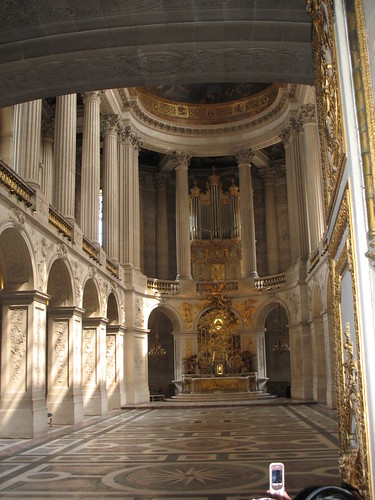


You can see the Royal Chapel before you actually have to produce a ticket. Check out the inlaid floor!

Lesson number one? BRING WATER. You are allowed to bring a half liter of water in a clear container, and you will want it, because there is literally nowhere to get any water once you are inside--unless you are willing to trek way out of your way, and who wants to do that?

The ticket we had entitled us to enter the palace, the gardens, the Grand Trianon and the Petite Trianon. As it was Saturday, we were also eligible to see "Les Grandes Eaux Musicales." That is when they actually run the fountains, plus play period appropriate music. Due to problems with water pressure, the fountains don't actually run all the time--which we hardly noticed, as there is so much else to see.

We had passes to see the exhibition that was running at the time, on the tradition of grand court dressing, as well as special tickets to see the State Apartments at sunset, after the museum closed. So what did we do first? Went to see the State Apartments.

Well, we didn't know what to expect, and we kind of got there by mistake. While we were waiting for Cris to come back with audio guides, the girls went into some rooms that promised to put Versailles into historic context. Cris thought that was a good idea as a starting point, but it turned out there was really no exit. Once in the course of the State Apartments, there was no good way to swim upstream and get out, so we went through instead.

It was not necessarily a bad thing, as it turns out. The State Apartments comprise room after room of fantastic and ornate decoration, one room debouching into the next moving from tributes to Hercules, Mars, Apollo, each room swimming in elaborate touches. Surely the next room simply can't be as elaborate as this one--but then, it is. All the different marbles on the walls, woods on the floors, plaster curlicues on the ceilings are enough to overload the eyes, but then it is all painted! And gilded! If there is any question about whether less is more. . .add more!

Really, it's overwhelming. The sheer exuberance of the decor is enough to make one tired and docile, as well as making one feel seriously underdressed.


When confronted with the roccoco nonsense that is the Hercules Ballroom (named for the figure above, centered on the massive fireplace), one feels that a three foot tall wig and five foot wide panniers are necessary just to avoid getting lost against the walls.


Sitting beneath the enormous painting (a gift from someone, and the reason the ballroom was built). You can see three different types of marble, as well as large swathes of gilded woodwork on the walls, and the parquet floor.


The Hercules Ballroom, looking toward the Heracles fireplace. It's a bit daunting, as we are realizing that our entire house would fit in this single room.

The King's Rooms take the entire south wing of Versaille--full of enormous paintings, elaborate fireplaces, marble busts of anonymous Romans, like this one:


Each room has several French doors that open out onto elegant gardens and parterres.


At the end of the King's Rooms is a small (relatively) parlor room that opens onto the famous Hall of Mirrors. There is a reason this is famous: it is astonishingly beautiful, even in a world where mirrors are NOT as expensive as diamonds.


Again, just try to get a sense of how large this place is, and just how over the top. Even the ceiling is painted.


Gilded lamp posts holding crystal sconces.


Dozens of crystal chandeliers as well. Not to mention the larger than life sized marble statues representing the Greek gods.

The scale is almost impossible to imagine.


(This is from the evening tour--after 6:30, which was definitely worth it, because we got to see the rooms with fewer people in the dramatic light of the setting sun.)


View from the east "Peace" parlor, marking the beginning of the Queen's Rooms.
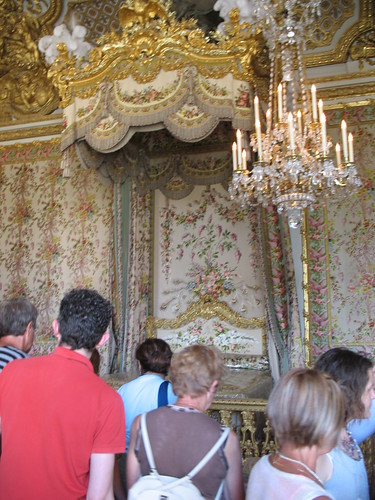


The canopy has to be twenty feet up in the air--Marie-Antoinette must have felt like a doll in that giant bed.


(edit by Mickey and Hannah, because we can even attack blog posts: A clock, so I always know what time it is...)

Even the mirrors in the Queen's Bedroom are decorated, and you can see the walls, ceiling, and the edge of the canopy as well.

While Marie-Antoinette is inextricably connected to Versailles, it is worth remembering that she had nothing at all to do with its construction or decoration. Built by Louis XIV, she was six generations away from him and merely inherited the "Queen's Rooms" when her husband became Louis XVI. The palace was already over 100 years old before she became Queen.

I found myself feeling sympathy for poor Marie-Antoinette--married to a man she had never seen at 14, shipped off to France and expected to live her life entirely in public--all because her five times great-grandfather-in-law had liked to live that way and had set his preferences into the concrete of protocol.

I mean, look at the level of decor in these rooms, which even when empty are a form of visual assault. Add furniture, hundreds of people, the sounds of their talk, the smells of bodies and perfume, the weight of being disliked for being Austrian--no wonder she felt the need to get away. To Petit Trianon, which is worth its own post.

Sainte-Chappelle and the Conciergerie

Let's talk about grim. Grim, dour, grey, depressing medieval fortress, build for keeping things inside. Let's talk about the Conciergerie.


Now back in the day--waaaaay back, that is--this was the palace of the king of France. Built on an island in the middle of the Seine, this is the castle of a king who is sleeping with one ear cocked for the sounds of invasion.


Sure, some of the bits were modernized as France stabilized, but this is still no fairy tale palace. This is the palace of able-bodied men sleeping with their swords to hand, in case they have to hack up some Visigoths or other uninvited guests.

Eventually, the building outlived its purpose and the last king (Louis XII?) who lived there tossed the keys to a caretaker. "Here ya go, it's all yours. Keep the parties modest, and turn out the lights when you go to sleep at night. I'm off to someplace less damp."

The caretaker--the concierge--became what the building was known for, hence its name. Time passed, and the Conciergerie was shoved back into prominence with the French Revolution, as well as the Terror. Many of the victims of the guillotine were kept overnight in the cells of this castle. In the morning, they were bound with hands behind their backs, their hair cut above their necks, then placed in the cart that took them to their execution--in what is now called Place de la Concorde. (Is irony an especially French thing?)

Marie-Antoinette spent the last days of her life here in a small cell. By this time her husband had been executed, her two remaining children taken from her, and she was tried and accused of every nasty thing that could be imagined, including incest with her own son. There was only one possible outcome, and she left the Conciergerie to her death.

Okay, so that's pretty grim. Which is why Sainte-Chappelle is such a contrast.

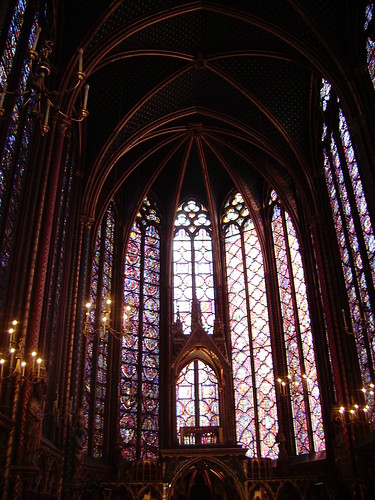
Built by Louis IX in the 13th century, it was the private chapel of the king and household, and was built to house the holy relics Louis purchased from a cash-starved emperor of Byzantium. Like a cereal box promotion, Louis managed to collect the whole set, and obtained the Crown of Thorns, the shaft and head of the spear that pierced Christ's side, a piece of the True Cross, a vial of Christ's blood, the sponge used to offer vinegar to Jesus, Christ's burial shroud, the top of the head of John the Baptist, and hair of the Virgin Mary. Well, if you are going to own all of that, you'd better have a nice place to keep it, right?


Oh, yeah. That'll do.

The thing is, it's got rather a tiny footprint, and is probably taller than it is long. It's like a jewel box of a chapel, and was designed for the king's personal worship, as well as that of his closest court members. Members of the household didn't come upstairs, but worshipped down in the undercroft.

Each of the window arches depicts a book from the Bible, and can allegedly be "read" if one is familiar with medieval conventions in Biblical representation. Which I am not. Which is why after being bowled over by the beauty and intricacy of these windows, I went back down into the undercroft to buy a Great Big Book of Window Explanations. Which we had to ship back here along with the other 40 pounds of books we bought, and hasn't yet arrived.


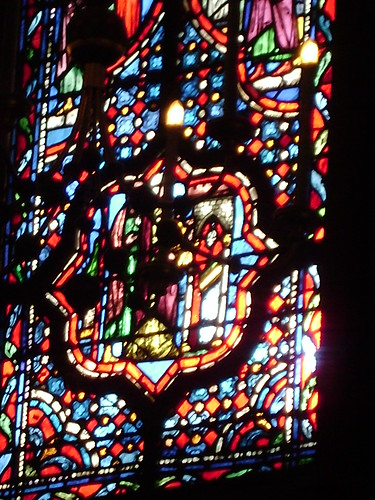
You can see the elaborate designs: figures, tableaux, geometric shapes, done in only a few colors with grisille detailing for the faces and drapery.


A closer look.


The windows start with Genesis at the back of the church on the left hand side, and move to the front, around the altar:


culminating in the magnificent rose window depicting Revelations, the apocalypse.


This (of course) faces west, so when the sun sets, it illuminates The End Of The World! In Technicolor!

I was going to end this with some witty quip, but the witty quip delivery boy is late. Tant pis.

L'Arc de Triomphe

Sure you know it. You've seen it. You'd recognize it anywhere. The Arch of Triumph, yadda yadda.


But have you really looked at it? How much do you really know?

Commissioned by Napoleon Bonaparte to commemorate his victory at Austerlitz in 1806, it followed typical French construction timetables, not being completed until well after the defeat and death of its patron. Sure, it was supposed to commemorate Napoleon's empire, but it wasn't finished until 1836, after the Bourbons were restored to the throne.

Eh, bien. Tant pis. Sure, the thing is covered with pro-Napoleon propaganda, but we'll just rename it in honor of the peace of 1815 and it's all good.

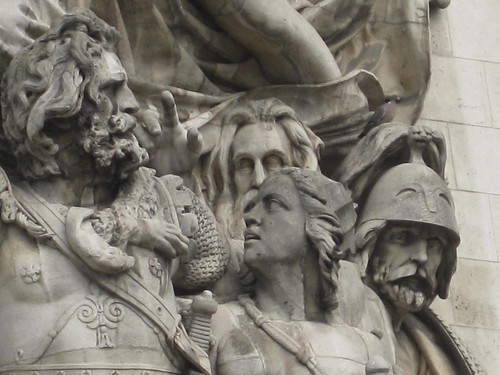
But take a look at the monumental sculpture! I had no idea it was so classical and beautiful. In fact, since we usually look at it from a distance, as in the photo above, it's easy to forget that there is more than just the arch. The sculpture panels and friezes are colossal.

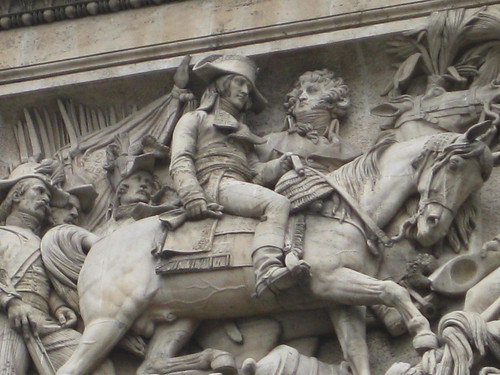
At the top left of the arc is a large scale panel showing Napoleon accepting the tribute of his defeated enemies. NB sits atop a large white horse:


as the conquered bow.


Okay, only one guy is bowing, but he's actually kowtowing, so it all evens out.

Across from this panel, two monumental gods? heroes? Greek warriors? adorn the curve of the arch.


Below that, still on the left side of the arch (as you look at the first photo) is a tribute to Napoleon.


It gets better when viewed up close:

NB, dressed in Roman fashion, stands victorious (note the sword) as he is being crowned by Glory with the laurel wreath of antiquity:


(Naked boobs are okay, if they are classical. )

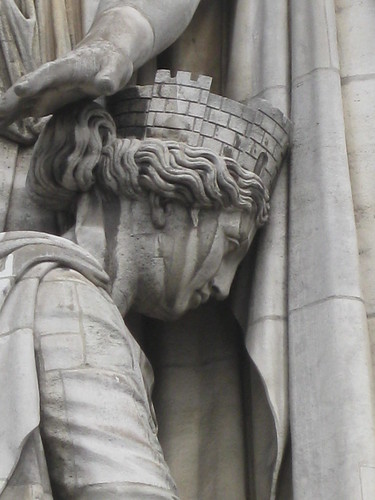
Meanwhile, his right hand gently hovers over the kneeling figure of defeated Europe, wearing a castle on her head to show his victory over kings and princes:


Let's get a close-up of that, shall we?


How that hand hovers, as if offering absolution and protection to the defeated!

Meanwhile, these deeds are being recorded by History!


Somehow I missed taking a close-up of the Angel Trumeting His Success To The World, although her toes are just above History's head, and you can kind of see her in the first photo of the grouping.

Quite the self-effacing guy, that Napoleon Bonaparte.

Realize, of course, that there is no real way to get a sense of the scale of this work if you are not actually standing beneath it. Here's my attempt to show some scale:


Random guy walking underneath one of the panels--he's a good six feet tall, and you can see the sculptures have to be at least 20 feet tall--or more.

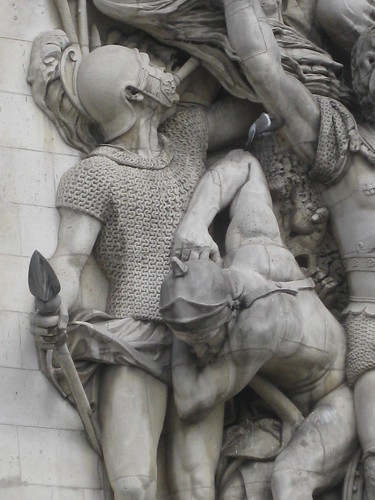
On another leg of the arc, we have War calling:


and the warriors assembling:


In another tableau, we see the Righteous Warrior Protecting the Honest Peasants:


He's looking pretty noble. Above his head is this celestial being, who is ensuring that the Warrior can fulfill his Oath of Protection:


And here are the cowering victims of war, clinging to the promise of peace and stability offered by the Noble Soldier.


"Don't let them get me! I'm too old to die!"


"I tell you, babies can sleep through ANYTHING."

Now aren't you glad that Napoleon brought his army through your village or hamlet? You probably didn't realize that you were better off. Fortunately, there is this triumphal arch to let you know.


Finally, we have Prosperity Under Peace Triumphant:


We have the Secure Peasant, able to farm with a plowshare rather than fight with a sword:


Babies are fatter and healthier now, and children may now learn to read:


Our Mighty Soldier stays Alertly on Defense to protect this prosperity:


And the whole is watched over benevolently by Peace, which remains armored, though crowned with the victory laurel.


That's some serious propaganda that arch wields. Too bad by the time it was actually complete, Napoleon had been defeated, returned, was defeated again, Charles X and Louis XVIII had lived out their reigns, and King Louis-Philippe was due to be overthrown in twelve years' time.

But really, timeliness hasn't really been a huge concern for the French. They took their tribute to a repudiated Emperor, and turned it into a memorial for all the fallen of all the French Wars--World Wars I and II, Vietnam, Korea, and probably some others I have omitted. They have even added a Tomb of the Unknown.


It turns out it is also a nifty metaphor for the country itself. For you can climb the Arc de Triomphe and look out from its top.


If you look to the East, you can peer down the Champs d'Elysees (named after the eternal paradise of the heroes from Greek myth) down to the Louvre--the former grand residence of the Kings of France.


Look to the west, and an equal distance away stand the glass towers of modern urban commercial life.


Eternally poised between the riches of the past and the wealth of the future, the fulcrum of the balance between Now and Then--that's poetical. And very French.

Saturday, July 11, 2009

Glamor Digs in Paris


Slowly working through the backlog of photos we took on this trip. Flickr claims we've uploaded over 1900 pictures, but that can't be true, can it?

Anyway, I came upon a collection of shots I took of the B&B where we stayed in Paris. Cris found it through this fabulous website called "Alcoves and Agapes" and it's truly a private home where they take in guests rather than a commercial location. Located within about two blocks of the Seine, it's also very close to the Eiffel Tower. How do we know it's close to the Eiffel Tower? Take a look at the view from our bedroom window:


Yeah, that close. It's actually across the river from the apartment, but we considered it less of an icon of Paris and more of a "next door neighbor." No, it did not stop by to borrow a cup of sugar, but it did light up at night, and put on a light show on the hour which helped us to keep time as well.


The apartment itself was spectacular and HUGE. Located in a Beaux Arts building which was built about 1923, it was on the first floor and reached by a sweeping marble stair or a tiny little metal elevator that held about one person at a time.


Hannah getting into the elevator. When we got our confirmation for staying here, the company suggested in charming pseudo-English that the elevator should be used "person by person, and luggage by luggage."

Once at the apartment, we were greated by the housekeeper, a young woman about my age who had come from Poland and had lived in Paris about 10 years. She did not speak English! But I spoke enough French and she really had some English that it worked out fine.

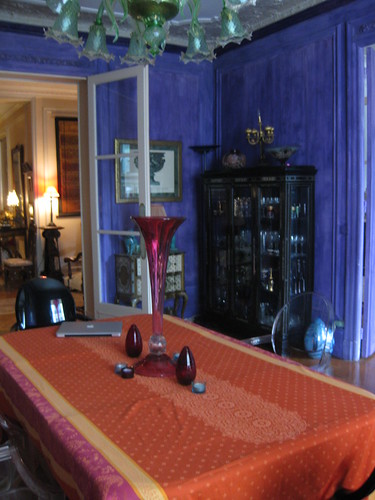
There is no way to convey the decor of the place, except to say that "It is very French." Lots of beautiful furniture of every possible different era and style, beautifully arranged bric-a-brac, and bold and unusual (or do I mean eccentric?) use of color.


The sitting room fireplace.


Art glass paperweights on a sidetable in the sitting room.


View from sitting room to dining room.


Two different views to the dining room. The room had an eclectic mix of furnishings--the dining room chairs were acrylic armchairs, two black, two clear. Beneath the window sat a pair of low upholstered arm chairs that were covered in shiny gold fabric. The chandelier was a vintage glass design I would guess was from the 1920s, and the curtains would not have been out of place from an Ikea store--although I would guess there were NOT Ikea.

The bedroom where Cris and I stayed had the walls covered in gray silk, and several collections of objet d'art scattered on the walls.


There was a fireplace here as well.


The bathroom was incredibly elegant--black and white and gold tile, golden fixtures, etchings (prints, most likely) on the walls.


I am pointing the camera into the mirror to show the wall above the bathtub. The bathroom was long and narrow like a galley, and this was the only way to show the print of Napoleon in Egypt that was above the bath. The gold fixtures at the bottom of the photo are the bath faucets.


Here you can see the second of the two sinks, the end of the bathtub, and in the balck alcove the shower. The wc itself was tucked to the right of the shower, behind the wall at the end of the bathtub.

Can you blame us for thinking we had found the coolest place to stay--EVAH?